%@LANGUAGE="VBSCRIPT" CODEPAGE="1252"%>
<% id = request.QueryString("ID")
if id ="" then id = 0 %>
Mission Environmental Products
Home
Animal Caused Outages
Solutions and Products
Technical Info
Endorsements
Home Page
Company Profile
Production Facility
Contact Us
Electrocutions
Collisions
Bird Streamers
Bird Pollution
Bird Nesting
Anti-Electrocution
Anti-Collision
Anti-Streamer
Anti-Bird Pollution
Research (Bird Deter)
Research (Right of Way)
Simulations
Longevity Testing
Loading,
Please Wait...
Endorsements
Bird Deter
Bird Flapper
<%
Select Case id
Case "0" %>
Introducing
a range of Mission Environmental Products that has been designed as an
anti-electrocution/collision devices by acting as a perch and flight deterrents.
The Problem
Many large birds, including raptors and storks are particularly vulnerable
to electrocution on electricity structures.
Where?
Electrical faults on transmission lines are an important source of power
disturbances. These faults have a variety of causes, including fires,
ice storms, lightning, insulator pollution, animal electrocutions,
and equipment failure. An important faulting mechanism that has to date
been largely overlooked, is bird streamers.
How?
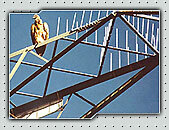
Long streams of excrement released by large birds, either perched or in
flight near a transmission line tower, can cause a flashover.
A streamer that bridges the distance
between the earth plane, namely the steel tower and a bird perched
on it above the insulator, and the nearest live hardware point, acts as
a fuse and results in an electrical fault. Physiologically, only larger
birds can cause such outages.
The
Solution
In the late 1990's, Eskom, South Africa's national electricity supplier,
started to experiment with bird guards on transmission lines to reduce
faults caused by bird streamers. Following on from the successes obtained,
it embarked on a national
program of fitting bird guards to transmission lines to reduce streamer
faults. A multidisciplinary team was formed during 1999 to investigate
and motivate this project and in the winter of 2000 installation commenced
and was completed early in 2002. This resulted in a reduction of 76% in
line faults within twelve months, with 10 of 18 lines fitted with bird
guards not recording any streamer faults since installation. This represents
a reduction from an all time high of 149 streamer faults in 2000 to an
all time low of only 36 faults for 2001.
<%
Case "2" %>
The
Mission Engineering Bird Guard (patented) was envisaged to address the problem
of bird roostings near critically dangerous hotspots on powerlines.
The prototype was tested in Hartebeestpoort (South Africa) to deter vultures
from specific test towers and was proved to be highly effective. The purpose
of the guard is not to harm the birds, but to prevent them from roosting
on specific target points on a power line. The device acts as a visual deterrent
and prevents them from landing on specific hotspots, although they may roost
closely by. The flexibility of the apparatus allows it to be bent and manipulated
on a host of different structures, positions and orientations.
Since the implementation,
280 000 metres have been installed worldwide. The Bird Guard product has
been approved by the World Wildlife Fund and Eskom Environmentalists. Scientific
studies (including technical data) conducted by the Endangered Wildlife
Trust in conjunction with Eskom and Mission Engineering are available on
request. The product has undergone rapid aging tests and di-electrical tests
and has proved to be a highly practical product, which has a 15-year guarantee.
This
product has been installed in Texas, Florida, New-Mexico and Colorado
with outstanding results. For a power outstanding value for money product,
contact Mission - Bird Guard for further Information. We now have distribution
centres in the U.S.A In conjunction with Eskom and the Endangered Wildlife
Trust (EWT), Mission Engineering have put together a consulting group
involving all scientist at the forefront of this technology with accumulated
data. This group is available to offer your company a specialsed solution
to your Avian Problems. This service is offered at no cost. A
fitment strategy would also be provided at no cost.
<% ' Company Profile
Case "3" %>
Mission Engineering's production
facility (for BIRD DETER) are based in Johannesburg, South Africa
and also include a distribution center in Texas (United States). In addition
to the manufactuer of BIRD DETER, Mission also have a full scale
engineering production facility that includes bending and rolling steel.
Mission Engineering are proud to offer a range of additional quality applications
including:
Plastic Extrusion
Pipes for the bird guards
Injection Molding
Bases for the bird guards
Small Rolling
small coils (10mm - 50mm)
Big Rolling
50-168mm, round 305sq. 305 I beams.
Guillotine
Cutting of sheet metal
Hydraulic Machine
(80 ton) steel cutter
Spot Welders
Punches, Dye Sets
for plate steel
Mission Engineering also hosts a comprehensive welding workshop with
capabilities including stainless steel, aluminium, mild steel, TIG
welding, MIG welding and arch welding. There is also the facility
to produce drawings including a consultant engineer and a structural
engineer.

<% ' Production Facility
Case "4" %>
Physical Address
Mission Engineering
137 Albert Street
Johannesburg
Telephone
+27 11 334-0882
Mobile
+27 82 338 6717
Postal Address
PO Box 520
Sturbensvalley
South Africa
1735
Thank you for your input. One or our consultants
will get back to you as soon as possible.
<% ' Contact Us Response
Case "6" %>
Raptors
and vultures instinctively seek out the highest vantage point as suitable
perches from where they scan the surrounding area for prey or carrion.
In flat, treeless habitat power pylons often provide ideal vantage points
for this purpose.
The vast majority of electrical structures were designed and constructed
at a time when the awareness of the danger that they pose for raptors
was very limited or totally absent.
Depending on the design
of the pole, a large raptor can potentially touch two live components
or a live and earthed component simultaneously, almost inevitably resulting
in instant
electrocution and a concomitant disruption in the electrical supply.
Electrocution via the bird streamer mechanism has also been identified
as a source of mortality among large raptors (picture: right) even where
the clearances make conventional electrocution impossible.
click
on image to zoom
click
on image to zoom
<% ' ACO - Electrocutions
Case "7" %>
The
problem of birds colliding with powerlines has received attention in Europe,
South Africa and the USA. In the Northern Hemisphere large numbers of
migrating waders are killed on powerlines. Up to 1996, it was generally
believed that collisions are not a major problem in South Africa, with
the exception of the three crane species.This may have been the case because
collisions with powerlines are seldom recorded through Eskom's internal
systems, as it seldom impacts on the electricity supply.
click
on image to zoom
However, a disturbing new picture has since started
to emerge from data gathered over the past six years, pointing to the fact
that collisions are indeed a major cause of unnatural mortality for several
threatened birds. Most heavily impacted upon are bustards, storks, cranes
and various species of waterbirds. These species are mostly heavy-bodied
birds with limited maneuverability, which make it very difficult for them
to take the necessary evasive action to avoid colliding with powerlines.
<% ' ACO - Collisions
Case "8" %>
click on image
to zoom
It is also a well known fact that excreta from birds using
the electricity structures in this manner can cause electrical faults.
Until recently, it was generally believed that bird pollution i.e. bird
excreta covering insulator strings, was the sole reason for these faults.
Click
to view footage
However, recent research has discovered that this mechanism
is not the only cause of faults related to bird excreta, but that the
so-called bird streamer also exists as an important mechanism.
An electrical fault is caused by a bird streamer i.e. a solid stream of
excreta emitted with some force by a large bird, when it bridges the entire
distance, or a sufficient part thereof, between the earth plane (the steel
tower and the bird perched above a conductor) and the nearest live hardware
point. The streamer therefore acts as a fuse and an electrical fault takes
place when the air gap breakdown occurs.
<% ' ACO - Bird Streamers
Case "9" %>
In generic terms an electrical fault is caused by pollution when pollutant
build up takes place on the insulator disks of power lines. The coating
of pollutant acts as an electrolyte when the strings are wetted by rain
or mist. This causes tracking on the insulator disks, until the string has
either partially or completely lost its insulation properties.
A phase to earth flashover then takes place across the insulator disks as
a result of the insulation breakdown. Bird excreta is a common form of pre-deposit
pollution that could result in an insulator losing its insulating properties
over time. Click
here to view diagram showing critical distance and power arc on a power
line.
It is also a well known fact that excreta from birds using
the electricity structures in this manner can cause electrical faults.
Until recently, it was generally believed that bird pollution i.e. bird
excreta covering insulator strings, was the sole reason for these faults.
<% ' ACO - Bird Pollution
Case "10" %>
Transmission towers are an important nesting substrate for many birds.
Unfortunately, nesting activities of certain bird species can interfere
with the electricity supply. Large raptors nesting above insulators can
pollute insulator strings and cause streamer related faulting. Crows and
ravens often use pieces of wire as part of their nesting material.
click
on image to zoom
This can cause flashovers when nests collapse and pieces
of wire bridge the air gap between the live conductor and the tower infrastructure.
Crows flying into the air gap with long pieces of wire can also cause
a flashover and cause the electrocution of the bird.
<% ' ACO - Bird Nesting
Case "11" %>
Safe on birds
Safe on the environment
The Problem
Many large birds, including raptors and storks are particularly
vulnerable to electrocution
on electricity structures.
Electrocution happens when the bird bridges the gap between live
components for example between two conductors (electrical wires
or phases), or between an earthed component (an earth wire or steel
pole connected to the earth) and a live component. The electrical
current is diverted through the bird, which causes a short circuit
(fault or flash-over) that usually kills the bird.
The Solution
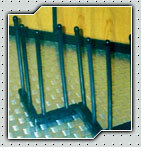
The Mission Engineering Bird Guard has been designed as an anti-electrocution
device by acting as a perch deterrent.
Experiments conducted by engineering firm EDM in Fort Collins, Colorado
proved it to be 100% successful in preventing large birds such as Golden
Eagles, Red-tailed Hawks from perching in dangerous areas on electricity
structures, thereby eliminating the risk of electrocution. It has also been
used in this manner in South Africa to successfully eliminate vulture and
cormorant electrocutions.
Other Products
Squirrel
Deter
The SQUIRREL DETER (in testing) can be installed on short power
conduits that prevent squirrel electrocutions. The device made from
High Density Polyethylene (HDPE) provides insulation for squirrels
that can short "live contact points".
Snake Deter
A snake detterant device made from 100% natural material, is fully
biodegradeable, inexpensive and has a simple application to deter
snakes (Soon to be released).
<% ' Solutions - Anti-Electrocutions
Case "12" %>
Safe on birds
Safe on the environment
Research
in South Africa
proved that a
dynamic device
is more effective
in reducing bird
collisions with
powerlines than
static devices.
The Mission Environmental
Bird Flapper
has been specifically
developed to address
the need for an
effective anticollision
measure to reduce
crane and bustard
mortality on powerlines.
It is a dynamic device designed to draw an approaching birds attention
to the powerline through a rotating disk suspended from a clip.
Clip Mechanism connects to Electrical Cable
<% ' Solutions - Anti-Collision
Case "13" %>
Safe on birds
Safe on the environment
The
Mission Engineering Bird Guard has proved to be a most effective deterrent
for electrical faults caused by bird streamers and bird pollution. The
device has been used in South Africa and Texas with success rates ranging
from 76% to 100%.
The
device blocks the critical area above the phase conductors for birds attempting
to perch or roost, thereby eliminating any streamers in the critical air
gap between the conductor and the pylon.
It also prevents the insulator disks from being polluted with bird droppings.
The demand for the device is growing worldwide, with current applications
in Africa and the USA. Interest has also been expressed from New Zealand.
<% ' Solutions - Anti-Streamer
Case "14" %>
Safe on birds
Safe on the environment
The
Mission Bird Guard has proved itself to be an excellent nesting deterrent.
It is currently used in this capacity in Florida, USA to prevent Ospreys
from nesting on wood poles. So far, it has proven to be 100% successful
in this role.
<% ' Solutions - Anti-Pollution
Case "15" %>
Click on the following images to view larger images of the different
configurational options that show the flexibility of the BIRD DETER.
Variable length pieces
Replaceable parts
Outer bends
on Y-axis
Outer bends
on X-axis
Inner bends
on Y-axis
Customized
bend application
Inner bends
on Y-axis
Customized
bend application
Inner bends
on Y-axis
<% ' Bird Deter Gallery
Case "16" %>
Studies
conducted by Eskom South Africa (The National Bird Guard Project)
have shown that the installation of bird deterrents, including BIRD
DETER, significantly reduce the faults on power lines.
The following summary is extracted from a paper presented by
Vosloo, H.F. and van Rooyen C.S at the IEEE.
The importance of power quality
> 7062 faults on Eskom Transmission lines between
1993 and 2001
> EPRI study-CEIDS: PQ costs $15-24Billion
> Affects consumer tremendously
Lines affected by
> Lightening, fires, birds
Contributors
> Bird streamers and Pollution (36%)
> Plants and Fire (33%)
> Lightning (25%)
> Other (6%)
> Cape Griffon, Lappetfaced Vulture, African Whitebacked
Vulture, Martial Eagle, Black Eagle, African Fish Eagle, Heron, Stork
Financial Justification
> Increase in sales, Decrease in OPEX, Environmentally
conscious, Economic benefit, legally imperative
> Cost of interruptions vs. cost of remedy
Project Fitment
> 46 lines qualified > Started in June 2000
> 18 lines fitted during 2000 > 32 fitted during 2001
More research information can be viewed from
the following list of prescribed papers:
HOBBS,
J.C.A. & LEDGER J.A. 1986a. The Environmental Impact of
Linear Developments; Powerlines and Avifauna. Third International
Conference on Environmental Quality and Ecosystem Stability. Israel,
June 1986.
HOBBS, J.C.A. & LEDGER J.A. 1986b.
Powerlines, Birdlife and the Golden Mean. Fauna and Flora 44:23-27.
KRUGER, R. & VAN ROOYEN, C.S. 1998.
Evaluating the risk that existing powerlines pose to large raptors
by using risk assessment methodology: the Molopo Case Study. 5th
World Conference on Birds of Prey and Owls: 4 - 8 August 1998. Midrand,
South Africa.
KRUGER, R. 1999. Towards solving raptor
electrocutions on Eskom Distribution Structures in South Africa.
M. Phil. Mini-thesis. University of the Orange Free State. Bloemfontein.
South Africa.
LEDGER, J. 1983. Guidelines for Dealing
with Bird Problems of Transmission Lines and Towers. Escom Test
and Research Division Technical Note TRR/N83/005.
LEDGER, J.A. & ANNEGARN H.J. 1981.
Electrocution Hazards to the Cape Vulture (Gyps coprotheres) in
South Africa. Biological Conservation 20:15-24.
LEDGER, J.A. 1984. Engineering Solutions
to the Problem of Vulture Electrocutions on Electricity Towers.
The Certificated Engineer 57:92-95.
LEDGER, J.A., J.C.A. HOBBS & SMITH T.V.
1992. Avian Interactions with Utility Structures: Southern African
Experiences. Proceedings of the International Workshop on Avian
Interactions with Utility Structures, Miami, Florida, 13-15 September
1992. Electric Power Research Institute.
VAN ROOYEN, C.S. & LEDGER, J.A. 1999.
Birds and utility structures: Developments in southern Africa. Pp
205-230 in Ferrer, M. & G..F.M. Janns. (eds.) Birds and Powerlines.
Quercus, Madrid, Spain. 238pp.
VAN ROOYEN, C.S. 1998. Raptor mortality
on powerlines in South Africa. 5th World Conference on Birds of
Prey and Owls: 4 - 8 August 1998. Midrand, South Africa.
VAN ROOYEN, C.S. 1999. An overview of
the Eskom-EWT Strategic Partnership in South Africa. EPRI Workshop
on Avian Interactions with Utility Structures 2-3 December 1999,
Charleston, South Carolina.
VAN ROOYEN, C.S. 2000. An overview of
Vulture Electrocutions in South Africa. Vulture News 43: 5-22. Vulture
Study Group, Johannesburg, South Africa.
VAN ROOYEN, C.S. & TAYLOR, P.V. 1999.
Bird Streamers as probable cause of electrocutions in South Africa.
EPRI Workshop on Avian Interactions with Utility Structures 2-3
December 1999. Charleston, South Carolina
VERDOORN, G.H. 1996. Mortality of Cape
Griffons Gyps coprotheres and African Whitebacked Vultures Pseudogyps
africanus on 88kV and 132kV powerlines in Western Transvaal, South
Africa, and mitigation measures to prevent future problems. 2nd
International Conference on Raptors: 2-5 October 1996. Urbino, Italy.
PRIMEN. 2001. The cost of Power Disturbances
to Industrial & Digital Economy Companies. Report to EPRI's
Consortium for Electric Infrastructure for a Digital Society (CEIDS).
Madison. WI.
Michener, H. 1924. Transmission at 220kV on the Southern California
Edison System. AIEE Vol. XLIII: 1223-1235.
West, H.J., J.E. Brown, and A.L Kinyon. 1971.
Simulation of EHV Transmission line flashovers initiated by bird
excretion. Paper 71 TP 145 - PWR presented at the IEEE PES Winter
meeting February 1971.
Burger, A.A., and K.J. Sadurski. 1995.
Experimental investigation of bird initiated AC flashover mechanisms,
CIGRE SC 33 -95 (WG07).
Taylor, P.V. 1999. Investigation into bird streamer caused transient
earth fault on a 275kV Transmission Grid. Unpublished Thesis, University
of Natal, Pietermaritzburg, South Africa.
Burnham, J.T. 1995. Bird streamer flashovers
on FPL Transmission lines. IEEE Transactions on Power Delivery 10(2).
Taylor, P.V., H.F. Vosloo, C.C.E. Wolmarans,
A.C. Britten, P. Naidoo, D.A. Hoch, and C.S. van Rooyen. 1999.
"Unknown" category of MTS line faults; bird streamers
as a cause of transient earth faults. Unpublished Progress Report,
July 1999. Eskom Transmission Group.
Vosloo, H.F. and C.S. van Rooyen. 2001a.
Summary report on the performance of the National Bird Guard Project.
Unpublished Report to Eskom Transmission Group. August 2001. Eskom.
Megawatt Park. Sandton.
Vosloo, H.F. and C.S. van Rooyen. 2001b.
Report on lessons learnt from the National Bird Guard Project. Unpublished
Report to Eskom Transmission Group. November 2001. Eskom. Megawatt
Park. Sandton.
Van Rooyen, C.S. 2001. Investigation
into fault risk behaviour by vultures on electricity structures.
Unpublished Report No RES/RR/01/15714. Eskom Resources and Strategy
Group. Research Division. Germiston. South Africa.
Stearns, R.D. 1982. Investigations of
unexplained outages on Sierra Pacific Power Company's 345 kV lines.
Bonneville Power Administration Report ERJ-82-22.
Van Rooyen C.S. and J.H. de Goede. 2000.
Audit of large raptor activity on transmission lines in the Western
Region. Unpublished Report to Eskom Transmission Group. Endangered
Wildlife Trust. Johannesburg.
Macey R. E. and W. L. Vosloo. 2001. Outages
of the Brand-se-Baai 132kV Feeder-The Pollution Problem That Wasn't.
Cigré 4th Southern Africa Regional Conference 2-4 October
2001, Cape Town South Africa.
<% ' Technical Info: Research (Bird Deter)
Case "20" %>
Right of Way managment in South Africa Hein Vosloo, Eskom.
Paper Abstract
Eskom
is the national electricity utility of South Africa and operates about
28 000km of high voltage Transmission lines (132kV and above) and about
250 000km of Distribution Lines (132kV and below).
The Right of way (ROW) of these power lines cover
the whole sub continent and traverses a number of biomes, ranging from
arid vegetation through grasslands and savanna, to tropical vegetation.
The analysis of about ten years’ line fault
data shows that plants cause over 20% of line faults, with a financial
impact estimated at R80m per year. Grass and other biomass fires in Africa
have been recognised as a problem by atmospheric scientists and has been
the subject of much research.
In a similar way, the interaction between
power lines and birds have detrimental effects for both birds and the
utility. The bird mitigation program has now been ongoing for a number
of years and the data collected shows the effectiveness of these measures.
Eskom has embarked on the development of a life cycle
management plan for its Transmission ROW’s. This plan covers the
total spectrum, from concept planning, through EIA and obtaining permits
to the maintenance phase and decommissioning of transmission lines.
As a major part of this plan, the maintenance of vegetation
in the ROW, in particular with regard to fires, receives much attention.
Most of the research on fire and fire behaviour has been executed by fire
ecologists, using fire as a tool for the management of grass lands for
the production of grazing or as a tool to mitigate against the densification
of shrubs in savanna.
This knowledge on fire behaviour has not yet been
used in the study of the flashovers that occur during fires under power
lines. During the Austral winter of 2003, Eskom embarked on a project
to systematically identify plant communities that pose a fire risk to
power lines. In addition to the botanical description, phytomass of these
plants and their fire behaviour, the spectral signatures for these communities
were also obtained. This will be used to later identify the problem plant
communities from the air.
This paper will discuss the methods that were
followed and report on the results obtained.
<% ' Technical Info: Research (Right of Way)
Case "17" %>
The following section
displays some of the photographic and video evidence of how bird streamers
are capable of causing severe power line damage via shorting.
Click on image to zoom
Click to view actual footage of
Bird Electrocution on powerline
Click on image to view the
Critical Distance on Powerlines
Click on image to view the
Placement Strategy of BIRD DETER
Click on image to dowload MPG Movie
Clip of "Bird Streamer" simulation using egg-yolk 19 sec. 1.7M
Click on image to dowload MPG Movie
Clip of "flash over" effects on factories 20 sec. 1.7M
<% ' Technical Info: Simulations
Case "18" %>
All
of Mission Engineering's technology has been thoroughly tested by the
South African Bureau of Standards to ensure proper product quality control.
Mission Engineering uses an American supply of HDPE (High Density Polyethylene)
which is 100% virgin material with additives that provide UV stabilization
with a guaranteed life-span of 15 years. The material has already
been used in the agricultural industry for irrigation purposes and has
seen no visible aging in up to 50 years of use.
The material used to manufacture BIRD DETER has gone through extensive:
<% ' Technical Info: Longevity Testing
Case "19" %>
South Africa:
> Eskom South Africa > Environmental Wildlife Trust
United States:
> EDM
> Texas Utility > Florida Power and Light
Mission
Engineering have received professional, commercial and environmental endorsements
from both within and South Africa and Internationally.
Their highly successful BIRD DETER has
been included as part of a nationwide "Bird Guard Project" conducted
by South Africa's largest power company, Eskom. This project was conducted
in conjunction with the Environmental Wildlife Trust of South Africa.
Other users of BIRD DETER
include EDM (USA), Texas Utility and Florida Power and Light, all of whom
have been using the product to drastically reduce bird-related fault incidents.
<% ' Endorsements: Endorsements
Case Else %>
Introducing
a range of Mission Environmental Products that has been designed as an
anti-electrocution/collision devices by acting as a perch and flight deterrents.
The Problem
Many large birds, including raptors and storks are particularly vulnerable
to electrocution on electricity structures.
Where?
Electrical faults on transmission lines are an important source of power
disturbances. These faults have a variety of causes, including fires,
ice storms, lightning, insulator pollution, animal electrocutions,
and equipment failure. An important faulting mechanism that has to date
been largely overlooked, is bird streamers.
How?
Long streams of excrement released by large birds, either perched or in
flight near a transmission line tower, can cause a flashover.
A streamer that bridges the distance
between the earth plane, namely the steel tower and a bird perched
on it above the insulator, and the nearest live hardware point, acts as
a fuse and results in an electrical fault. Physiologically, only larger
birds can cause such outages.
The
Solution
In the late 1990's, Eskom, South Africa's national electricity supplier,
started to experiment with bird guards on transmission lines to reduce
faults caused by bird streamers. Following on from the successes obtained,
it embarked on a national
program of fitting bird guards to transmission lines to reduce streamer
faults. A multidisciplinary team was formed during 1999 to investigate
and motivate this project and in the winter of 2000 installation commenced
and was completed early in 2002. This resulted in a reduction of 76% in
line faults within twelve months, with 10 of 18 lines fitted with bird
guards not recording any streamer faults since installation. This represents
a reduction from an all time high of 149 streamer faults in 2000 to an
all time low of only 36 faults for 2001.